
12 Major Traffic Violations in Korea
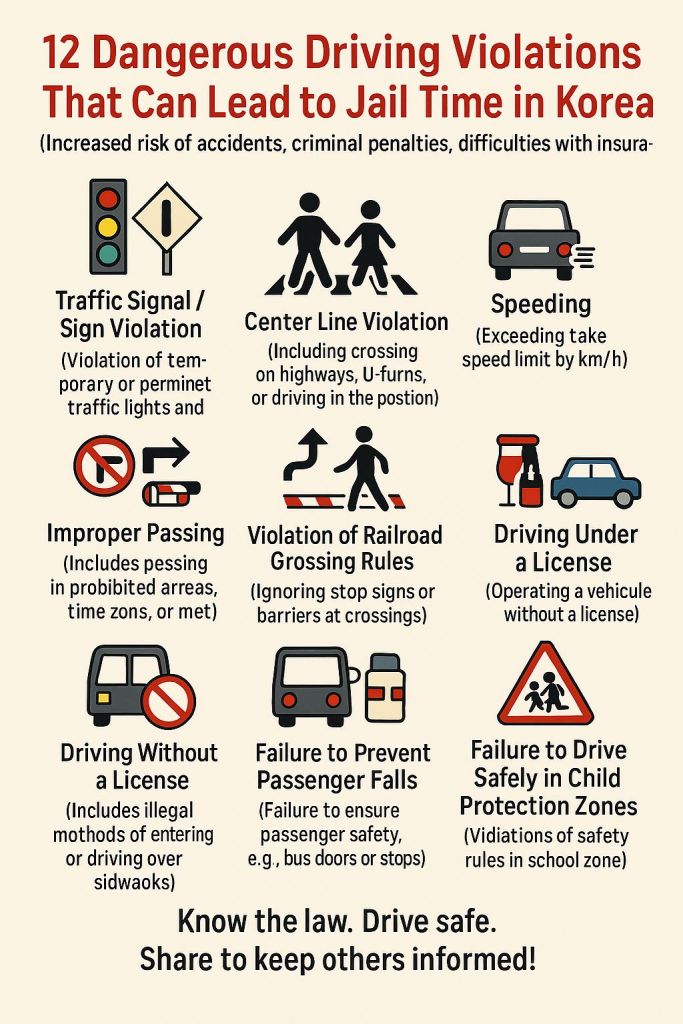
In Korea, accidents caused by any of these 12 major traffic violations result in severe penalties, including criminal charges and insurance complications. Understanding these violations can help you stay safe and compliant with local laws.
1. Signal Violation (신호위반)
Disobeying traffic signals, such as running a red light, is a serious offense in Korea. This violation frequently leads to dangerous intersection collisions and puts both drivers and pedestrians at significant risk.
2. Center Line Violation (중앙선 침범)
Illegally crossing the center line or median strip is strictly prohibited. This dangerous maneuver can result in head-on collisions, which are among the most deadly types of traffic accidents due to the combined force of impact.
3. Speeding (과속)
Driving significantly over the speed limit reduces control over your vehicle and increases both the likelihood of accidents and their severity. Korean traffic authorities enforce speed limits rigorously, especially in urban areas and school zones.
4. Illegal Passing (앞지르기 방법 위반)
Passing vehicles illegally or dangerously, such as in no-passing zones or on blind curves, creates hazardous situations that can lead to multi-vehicle accidents. Proper passing techniques are essential for road safety.
5. Railroad Crossing Violation (철길 건널목 통과방법 위반)
Violating railway crossing signals or gates is extremely dangerous. Collisions with trains almost always result in catastrophic consequences due to the tremendous mass and force of trains, often leading to fatalities.
6. Crosswalk Violation (횡단보도 보행자 보호의무 위반)
Failing to yield to pedestrians at crosswalks is taken very seriously in Korea. Pedestrian safety is prioritized, and drivers must come to a complete stop when people are using or waiting to use crosswalks.
7. Driving without a License (무면허 운전)
Operating a vehicle without a valid driver’s license is illegal and demonstrates a disregard for public safety regulations. This includes driving with an expired, suspended, or inappropriate class of license for the vehicle being operated.
8. Driving Under the Influence (음주운전)
Driving after consuming alcohol or drugs above legal limits is one of the most serious traffic violations in Korea. Even small amounts of alcohol can impair judgment and reaction time, leading to severe accidents and harsh legal consequences.
9. Sidewalk Violation (보도침범)
Driving onto or across pedestrian sidewalks endangers pedestrians who rightfully expect these areas to be safe from vehicular traffic. This violation is particularly dangerous in crowded urban areas where many pedestrians may be present.
10. Hit-and-Run (뺑소니, 도주사고)
Leaving the scene of an accident without reporting or assisting is not only morally reprehensible but also severely punished under Korean law. This violation can transform a minor accident into a serious criminal offense with severe penalties.
11. Violation of Passing Restrictions on Highways (고속도로에서 앞지르기 위반)
Illegal or unsafe passing on highways, such as using shoulders or restricted lanes, creates dangerous situations at high speeds. Highway safety rules are strictly enforced due to the potentially catastrophic nature of high-speed collisions.
12. Cargo Spill Violation (화물고정조치 위반)
Failure to secure cargo properly, causing spills or hazards on roads, endangers other road users. Falling debris or spilled materials can cause accidents directly or force other drivers to make dangerous evasive maneuvers.
Important: Accidents involving these violations typically result in severe legal consequences, including potential criminal prosecution, heavy fines, license suspension or revocation, and increased insurance liabilities.
Always drive safely and adhere to traffic regulations to avoid severe penalties and ensure everyone’s safety.
RoadSafetyKorea #TrafficLaws #DrivingSafety #KoreaDriving #KoreaTrafficViolations #DrivingInKorea #TrafficSafety #RoadSafety #SafeDriving #교통법규 #교통위반 #한국운전 #교통안전 #교통사고예방 #안전운전 #TrafficRules #DriverEducation #ExpatsInKorea
 All About Auto Insurance in Korea